SIBOS PANEL
Trust at agentic speed: reimagining corporate identity in an AI-driven economy

Need further assistance? Visit Support Centre
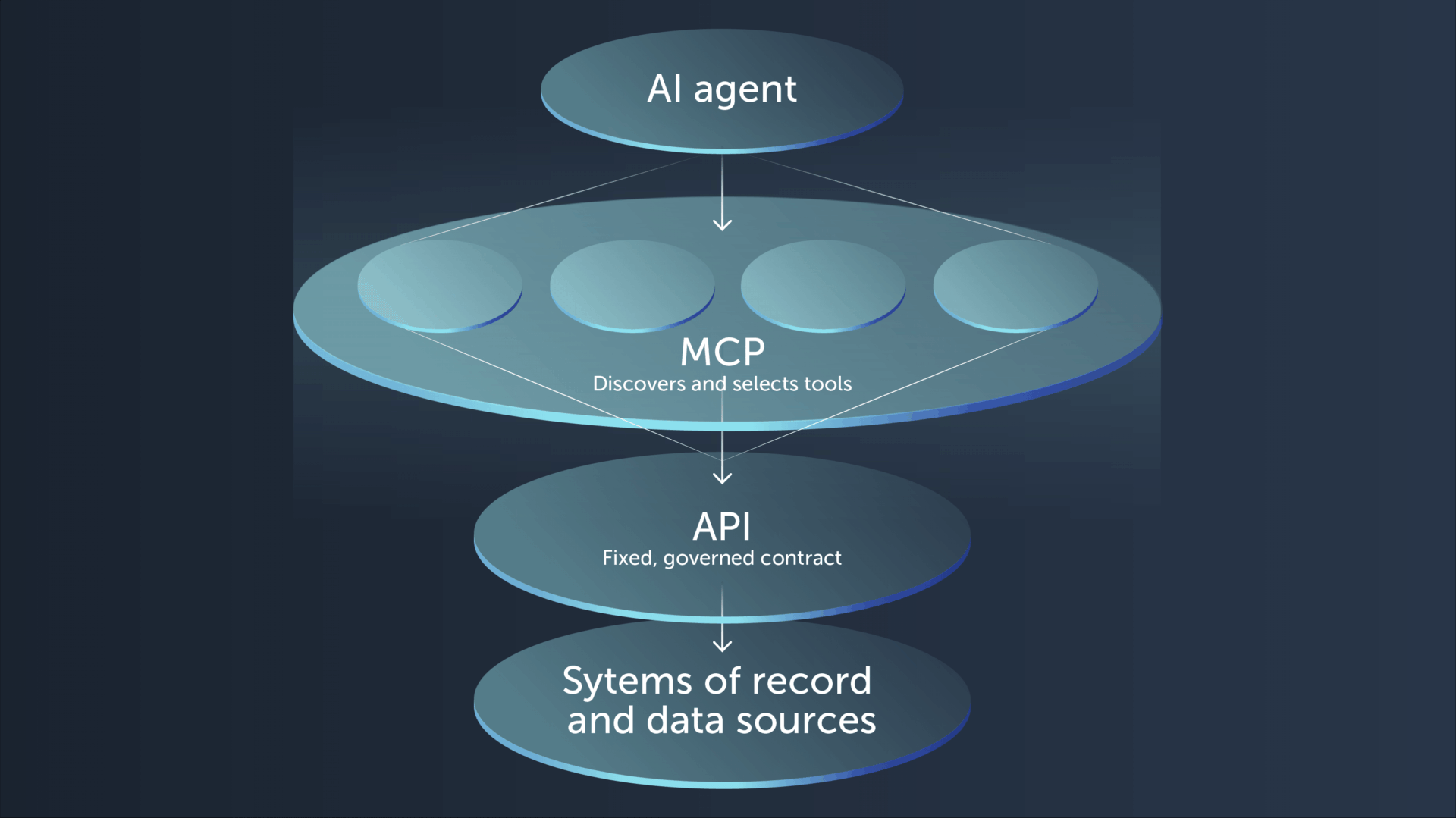
What is the difference between an API vs MCP? An application programming interface (API) is a fixed, pre-agreed contract for moving specific data between systems. By contrast, Model context protocol (MCP) is a standard that lets an artificial intelligence (AI) agent discover the tools and data sources available to it and choose which ones it needs for a given task.
APIs define what can move and under what conditions. MCP is how an agent finds that contract and calls it correctly. Banks need both. As AI agents take on more of the day-to-day work inside engineering and operations teams, how those agents connect to systems has become a practical question rather than a theoretical one. Getting the distinction right matters for anyone building, buying, or governing AI-driven infrastructure in financial services.
An API defines a known, fixed set of operations that two systems agree on in advance, usually versioned and documented by engineering teams on both sides. Fetch this record. Submit this document. Return this status. The contract does not change at run time. Every call an API accepts, and every response it returns, is defined ahead of time.
That predictability is why APIs remain the backbone of regulated data exchange. In know your customer (KYC) and anti-money laundering (AML) compliance, a bank needs to know precisely what data can move, under what conditions, and with what audit trail. An API contract gives compliance and risk teams that certainty.
MCP solves a different problem: giving an AI agent a standard way to see what tools and data sources are available to it, understand what each one does, and decide which it needs for the task in front of it.
This does not mean the integration work disappears. Someone still builds the MCP server. Rather, what changes is the shape of that work. Instead of hand-building a separate path for every combination of agent and system, a capability is exposed once as a tool, in a standard form, and any compliant agent can find and call it. That is what makes MCP useful for agents specifically, and it is why MCP is not a replacement for an API.
No. MCP does not replace an API, it describes one. Specifically, an MCP server exposes existing capability as tools: named operations, each with a description of what it does, what it needs as input, and what it returns. That description is what an agent reasons over when it decides what to call.
The API underneath still defines exactly what data can move and under what conditions, and in a regulated environment that definition should not disappear. What MCP adds instead, is a consistent way for an agent to find that operation and call it correctly, treating it as one available tool among several rather than a path a developer had to wire up by hand.
There is a distinction here that is easy to skip past, and it is the one a risk function will ask about first. An API call is deterministic. The same input follows the same path and produces the same audit line, because a developer decided in advance which call would be made.
Agent tool selection, however, is not. The agent chooses. It can pick the right tool with the wrong arguments, call three tools where one would do, or use a tool that is technically permitted but not appropriate for the case in front of it.
That is the new risk MCP introduces. It is manageable, though not automatically. Auditability is not inherited from the protocol. Rather, it comes from the controls placed around it: credentials scoped to what that agent is entitled to see, every tool call logged with its arguments and its result, and an API contract underneath that refuses anything outside its definition.
When this is done properly, the agent gains flexibility in how it works while the boundary of what it can do stays exactly where compliance set it.
As agents take on work once handled by developers, reviewers, and quality assurance specialists, every action they take still needs to be traceable. In KYC and AML workflows, in particular, that traceability is not optional. A reviewer or a regulator will ask which sources were used, when, and on whose authority.
APIs remain the trusted record of what is permitted. MCP is the connective layer that lets agents use those permissions at scale, without a compliance team losing visibility into what changed and why.
EC360 is Encompass’s corporate digital identity (CDI) platform. A bank’s systems call it through a defined API: request a CDI profile for a corporate entity, and receive structured data with every fact carried back to the source it came from and the date it was retrieved. The contract sets what can be asked for and what comes back.
In practice, a single piece of analyst work runs across several of those contracts. Resolve a corporate entity against an authoritative registry. Retrieve its ownership structure. Next, walk that structure to identify the ultimate beneficial owners. Screen the resulting parties. Traditionally a developer sequences those calls in advance, and any variation means new code.
With MCP, by contrast, an agent can select and sequence them itself, based on what the case actually requires, while each step still lands against the same API contract and produces the same evidence trail an analyst or an auditor would expect. The flexibility sits in the sequencing. The governance stays in the contract.
| API | MCP | |
|---|---|---|
| Purpose | Defines a fixed, known operation between two systems | Lets an AI agent discover and select from available tools at run time |
| When it is defined | Agreed and versioned in advance by engineering teams on both sides | Tools are defined in advance by whoever builds the server. Discovery and selection happen at run time |
| Who decides what happens | The developer, in advance, through the contract | The agent, during the task, within scoped permissions |
| Best suited to | Known, fixed, auditable operations | Flexible, multi-step agent workflows |
| Role in a regulated environment | The governed contract for what can move | The layer that helps agents use that contract correctly |
These are not competing standards. Rather, they are complementary layers, and the one that cannot be skipped is the API. In banking, the combination is what lets AI agents work at speed without loosening the governance regulated institutions depend on.
 Blog Blog Blog
  Video
Video