SIBOS PANEL
Trust at agentic speed: reimagining corporate identity in an AI-driven economy

Need further assistance? Visit Support Centre
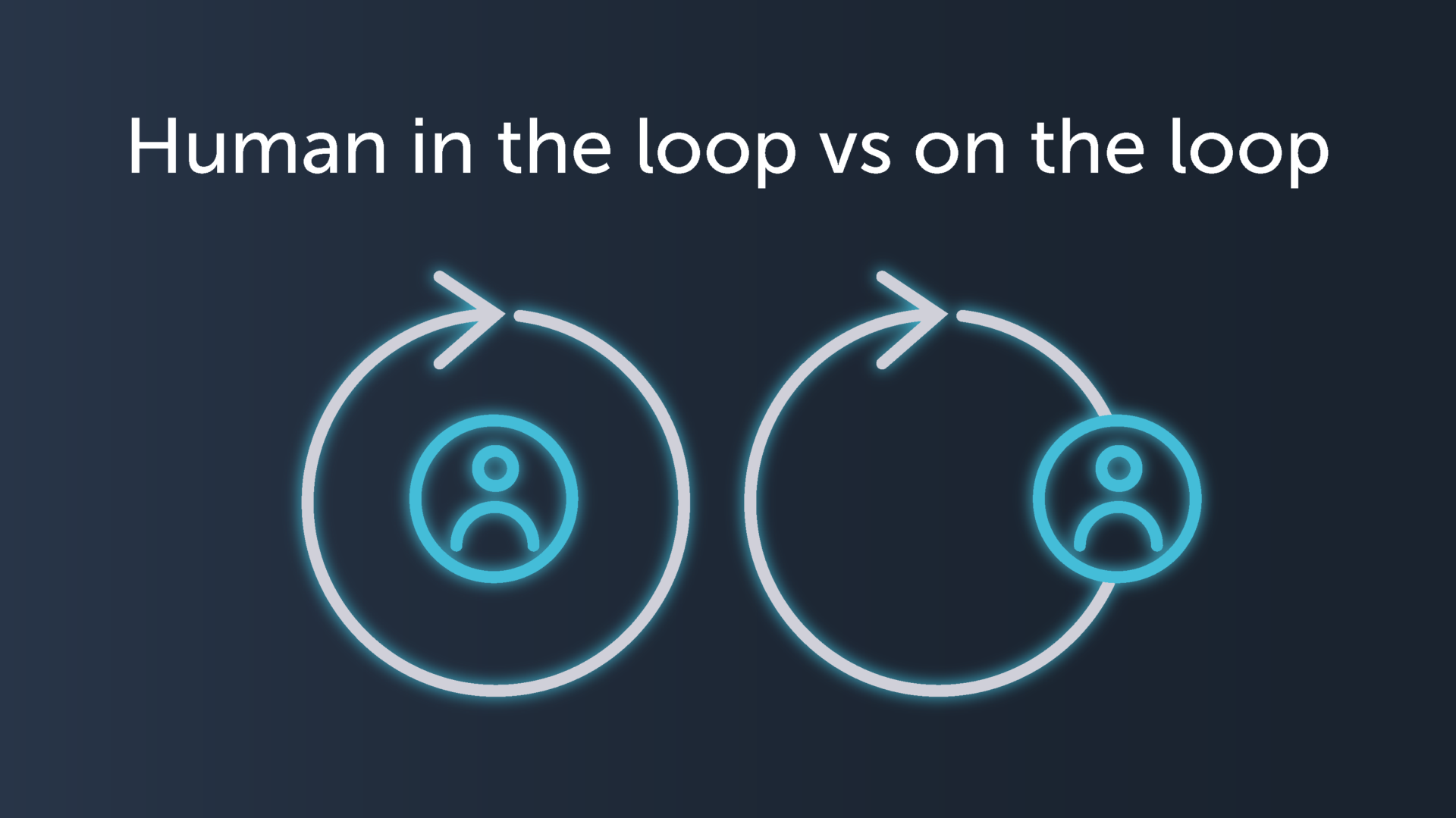
For most of the past decade, “human in the loop” has been the default safeguard for AI in banking. Whatever the system produces, a person checks it before it counts.
Few banks have asked how well that safeguard actually works. At our ‘Trust at agentic speed panel at Sibos 2026′, Sameena Shah (Chief AI, Data and Transformation Officer, J.P. Morgan) described a move toward “humans on the loop rather than in the loop,” with people overseeing flags and exceptions instead of reviewing every case.
The logic is sound. Human review is not a perfect control. Experienced analysts reach different conclusions on the same file. Procedures are interpreted differently across offices. Fatigue sets in on high-volume, repetitive work. A person in every loop does not guarantee quality. It guarantees cost and delay.
But there is a trap on the other side. Moving people onto the loop without the right foundations does not reduce risk. It hides it. In our work with Tier 1 banks on corporate know your customer (KYC), five foundations make the difference, and many banks are missing at least one.
What banks can get wrong: they assume their policy is applied the same way everywhere.
When banks first deploy agents, many apparent AI errors turn out not to be AI errors at all. They are gaps in procedure. Global teams have been doing the same task in slightly different ways for years. The agent, working from the documented policy, simply exposes the inconsistency.
That inconsistency did not arrive with AI. It was a compliance exposure all along. Regulators expect the same policy to produce the same result in every jurisdiction, and a bank that cannot show that has a problem whether or not it uses agents. Encoding policy so it is applied the same way every time is the first prerequisite for scaling oversight down.
What banks can get wrong: they cannot say how accurate their current process is.
You cannot show that an agent performs better than your current process if you have never measured that process. Few banks can quote their analyst error rate, how often files are reworked or which checks are most often missed.
Before changing oversight, banks need a clear view of how consistently analysts apply policy today. That baseline turns a subjective debate about trusting AI into an evidence-based decision. It also gives risk and compliance teams a benchmark to monitor against once oversight changes.
What banks can get wrong: they focus on the model and assume the data will follow.
An agent’s output can only be as reliable as the data it reasons over. If the inputs are stale, incomplete or impossible to trace, a faster process simply produces unreliable answers more quickly.
This is why corporate digital identity (CDI) matters. A CDI profile is a structured, continuously maintained view of a corporate client, built from authoritative public sources and private client information, with the source and timestamp of every data point recorded. When the reviewer on the loop asks where a fact came from, there is an answer.
What banks can get wrong: they move people onto the loop without changing what those people can see.
A human on the loop is only effective if they can see, immediately, what the system concluded and why. Every outcome should show which sources were used, which rule was applied, and where data conflicted or fell short.
Exceptions must also surface on their own. Complex ownership structures, conflicting registry records and adverse findings should be routed to people automatically. Skilled analysts should spend their time on judgment, not on confirming work that was already correct.
What banks can get wrong: they treat the change as a switch rather than a spectrum.
A low risk, publicly listed subsidiary does not need the same review as a high-risk client with a layered offshore structure. Banks should define oversight by risk tier: straight through processing (STP) where the evidence supports it, a human on the loop for most standard cases, and a human firmly in the loop for the highest risk decisions.
Governance must lead. Guardrails, monitoring and escalation paths should be in place before volumes increase, not after. And because analysts who have worked one way for years will not change habits overnight, adoption deserves as much investment as the technology.
If you cannot answer yes to all five, your bank is not yet ready to move people onto the loop.
How Encompass helps banks get there
Encompass partners with Tier 1 banks to put each of these foundations in place.
The shift from in the loop to on the loop is not about trusting AI more. It is about building a process that deserves trust: consistent policy, a measured baseline, sourced data, explainable outcomes and oversight matched to risk.
Banks that build these foundations first will move faster with more confidence. Those that skip them risk discovering their gaps the hard way, in front of a regulator.

Michael has over 20 years' experience in hands on sales and leadership positions for the provision of data and software to Financial services and Multinational corporates. More specifically, this experienced is aligned to KYC, KYB, Due Diligence, Firmographics, Surveillance, Counter Terrorism, Sanctions, Political Exposure and the march in technology to optimise the delivery and deployment of solutions in the space. Michael heads up Encompass' commercial efforts in the USA and UK and remains both excited and curious to the advent and relentless progression of AI driven technologies and their applications in the adoption of KYC best practices.

 Video
 Blog Blog Blog