SIBOS PANEL
Trust at agentic speed: reimagining corporate identity in an AI-driven economy

Need further assistance? Visit Support Centre
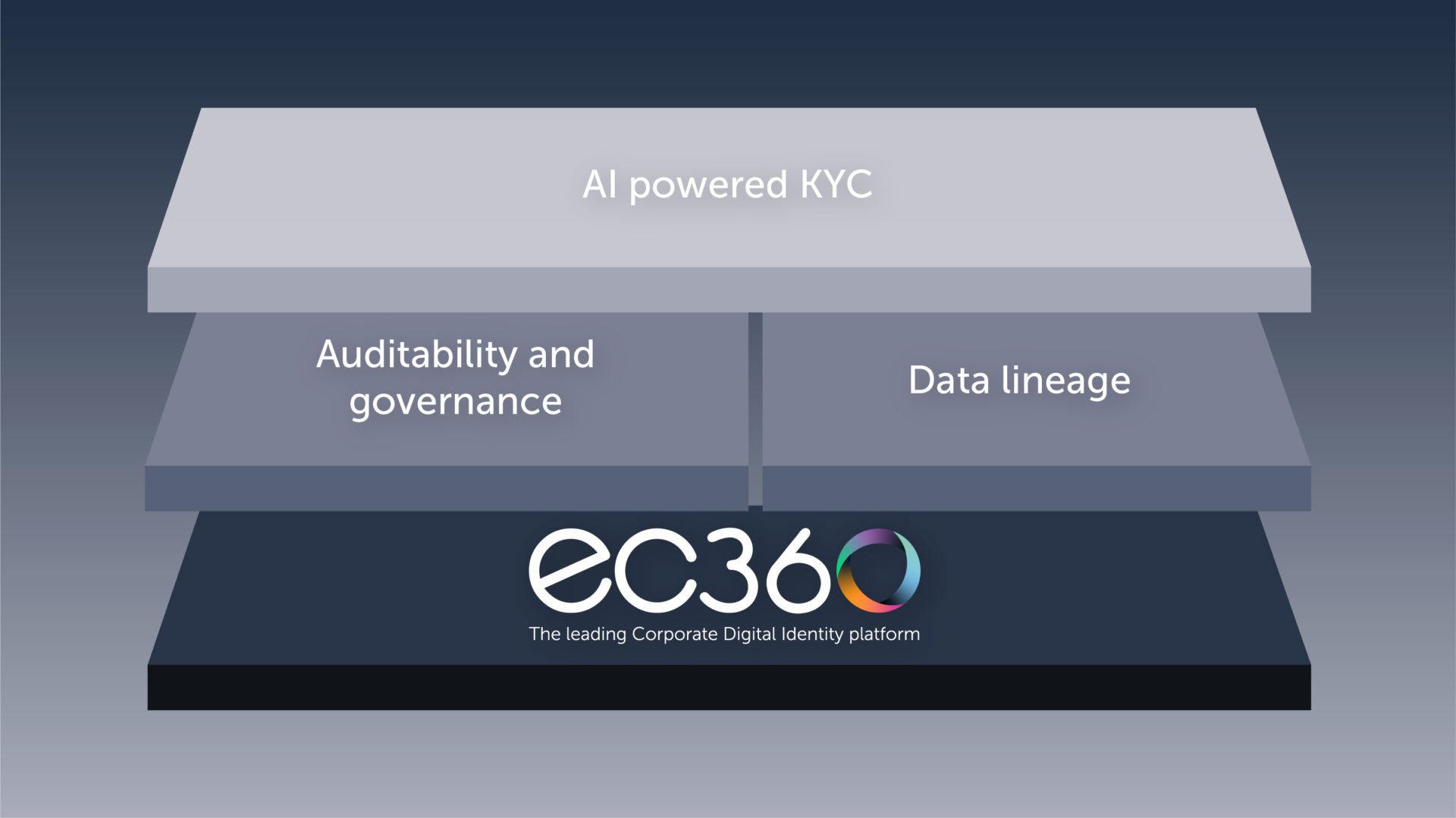
The debate whether to build or buy KYC technology is one that banks have been having for years. Ask it again in 2026, and you’re asking the wrong question.
The right question is: which approach lets you run AI in production, at scale, with the governance, data quality, and auditability that regulators now demand?
65% of financial institutions are now actively using AI, up from 45% just a year earlier. 42% are already using or assessing agentic AI, with 21% having moved it into production.
Most legacy KYC frameworks, including many custom-built at significant expense, rely on rules-based engines and static risk scoring. These architectures were never designed to feed machine learning models, which require structured, trusted, and continuously refreshed entity data. Without that foundation, automation doesn’t eliminate errors. It amplifies them.
The frontier in 2026 is orchestrated multi-agent workflows, where AI agents coordinate across data retrieval, risk assessment, and decision documentation simultaneously. Early adopters are reporting dramatic efficiency gains. But those gains depend entirely on the quality of the underlying data. This is where Corporate Digital Identity (CDI) becomes the foundation that makes AI trustworthy.
One capability distinguishes genuinely AI-ready infrastructure from everything else: data lineage. Regulators will ask where each data point came from, when it was last refreshed, and whether the institution can reproduce the exact state of the record that drove a given decision.
That is a data-lineage problem, not an analytics problem. And it is the single hardest capability for an in-house build to replicate.
Build: Banks that built in-house now face a second wave of investment to retrofit AI capabilities. Adding model governance layers, structured data pipelines, and audit trail architecture onto foundations that were never designed for them.
Buy: The right question when evaluating a platform today is whether it produces the structured, verified, auditable data that AI models require, and that regulators will scrutinize.
Blend: The blended model remains the most strategically sound approach. Previously, the blend was between in-house policy control and external data sourcing. Today, it’s between human oversight and AI-enabled automation, with CDI as the shared infrastructure layer that makes both work.
Banks retain ownership of risk appetite, policy configuration, and decision governance. Encompass provides the entity data infrastructure, AI model inputs, and continuous monitoring that would take years and significant capital to replicate internally.
Regulators want proof that controls work, and evidence that AI-driven decisions are reached, documented, and audited.
From August 2026, AI systems used in AML and KYC are likely to be classified as high-risk. Bringing enforceable obligations on transparency, data governance, human oversight, and third-party accountability. They will need to demonstrate, at any point, the governance and data quality that underpins every automated output. Critically, institutions retain full regulatory accountability even when AI is vendor-supplied. The data and audit architecture beneath the AI matters more than ever, and a mature vendor platform built around that requirement is a structural advantage over an in-house build that must retrofit it.
The EU’s AMLR caps review periods at one year for higher-risk clients, while AMLA introduces harmonized supervisory standards across all 27 member states. DORA, live since January 2025, places heightened scrutiny on third-party ICT providers; a structural strength of mature vendor platforms over in-house teams that often lack equivalent resilience maturity.
SR 11-7 and SR 21-8 together require banks using AI in KYC to demonstrate model validation, performance monitoring, documented governance, and clear accountability, regardless of whether the model was built in-house or sourced externally.
The UK’s Economic Crime and Corporate Transparency Act has strengthened verified ownership data. In the United States, the Corporate Transparency Act has been significantly narrowed, but core Bank Secrecy Act obligations remain fully intact, and financial institutions are still required to collect, verify, and document beneficial ownership for legal entity customers under FinCEN’s CDD rule. Australia’s Tranche 2 reforms are broadening the compliance perimeter significantly from mid-2026.
Across every major jurisdiction, the direction of travel is the same: dynamic, continuous, evidenced compliance – at scale.
The build vs. buy debate has always contained a hidden assumption: that each option is an equivalent starting point. It isn’t.
A bank building from scratch today isn’t starting where a mature vendor’s platform started ten years ago. It’s starting a decade behind. But the deeper issue isn’t time. It’s data lineage.
When a regulator scrutinises a KYC decision, the questions are precise: Where did each data point come from? When was it last refreshed? Can you reproduce the state of that record at the moment the decision was made?
That is a data lineage problem, and the single hardest thing for an in-house build to replicate.
At Encompass, we’ve spent over a decade building and refining the CDI infrastructure layer: connecting to authoritative data sources globally, normalizing entity data at scale, maintaining verified golden records, and developing the audit architecture that answers exactly those regulatory questions.
When banks build on that foundation they’re acquiring the data lineage infrastructure, regulatory credibility, and production-grade AI capability, along with a decade of compounded learning from regulatory and data change that an in-house team would have to absorb from scratch.
The most important KYC technology decision isn’t how you build. It’s what you build on.

 Blog Blog Blog
  Video
Video