SIBOS PANEL
Trust at agentic speed: reimagining corporate identity in an AI-driven economy

Need further assistance? Visit Support Centre
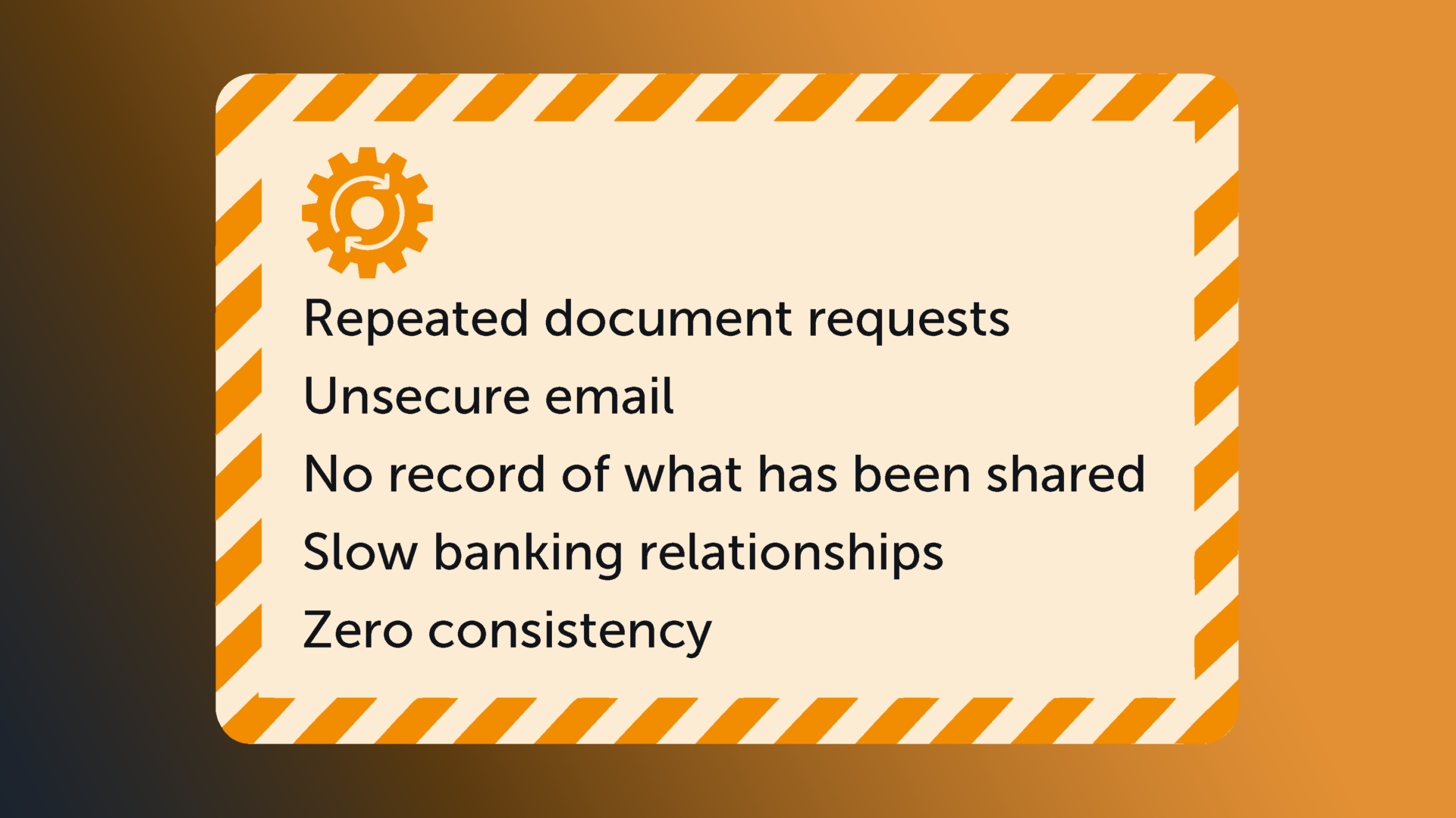
Five signs your KYC process needs an upgrade are; repeated document requests; sensitive data shared by email; no record of what you’ve shared with which bank; onboarding delays; and a different process for every bank.
These problems matter more now because banks are connecting AI agents to their compliance workflows. But those agents work best with structured, verified data, not scanned documents in an inbox.
There’s a difference between KYC being an unavoidable requirement and KYC actively holding your business back. If your current process falls into the second category, the cost in time, revenue, and risk, is higher than you might realize. Banks are now building AI agents directly into their compliance stacks. As a result, businesses still stuck on manual, document-heavy KYC are falling further behind every quarter.
If this sounds familiar, you’re not alone. Encompass Corporation’s 2026 Corporate Treasurers Report found that most corporates are still being asked for the same information multiple times by their banks, for the third year running. The same certificates, ownership structures, and director IDs. Submitted, resubmitted, and submitted again in a slightly different format.
This isn’t due diligence. It’s dysfunction. Every hour your team spends re-packaging and re-sending information that already exists is an hour not spent on work that drives the business forward. The same report found that 97% of treasury professionals say time spent managing KYC requests diverts their team from work that drives growth.
Even regulators are starting to recognize the problem. In February 2026, the US Financial Crimes Enforcement Network (FinCEN) relieved banks of the requirement to re-identify the beneficial owners of a business customer every time it opens a new account. Banks now only need to do this when a customer first opens an account. Or when they have reason to doubt the information they already hold, or as their own risk-based procedures require. That’s welcome news, but it only helps within a single banking relationship. If you bank with five institutions, you’re still supplying the same ownership information five times.
A modern KYC process stores your information once, structures it correctly, and makes it ready to share at a moment’s notice, without starting from scratch every time a new request arrives.
Think about what’s in those KYC document packs: corporate ownership structures, director passports, shareholder registers, financial statements. Now think about where most of that information ends up. Probably attached to an email, sitting in someone’s inbox, forwarded to a colleague, possibly lost in a thread from three months ago.
Unprotected email is not a secure channel for sensitive corporate data. It creates audit gaps, exposes your organization to security risks, and gives you zero visibility over who has seen what and when. This concern is growing, not shrinking: 92% of treasury professionals now report security concerns when sharing sensitive KYC information, up from 83% just a year earlier, according to the 2026 report. As banks bring AI into how they handle client data, questions about where that data lives and who, or what, can access it are becoming sharper, not softer.
If email is still the backbone of your KYC process, that’s a serious vulnerability, and a sign your approach hasn’t kept pace with the threat environment.
Here’s a simple test: can you tell, right now, which documents you’ve shared with each of your banking partners, and whether any of them have expired?
For most treasury teams running manual processes, the honest answer is no. The 2026 report found that 95% of organizations store KYC information across multiple systems and teams. A further 95% say they lack adequate visibility and control over KYC information requests. Documents are scattered across email threads, shared drives, and individual inboxes. There’s no centralized record, no audit trail, and no easy way to stay on top of what needs to be refreshed and when.
That’s not just operationally painful, it’s a compliance risk. Regulators expect traceability. Your banks expect accuracy. And when something goes wrong, “we think we sent that last year” isn’t a defense.
Opening a new bank account shouldn’t feel like a months-long ordeal. But for many corporates, it does. The knock-on effects are real and, according to the 2026 report, getting worse. 96% of organizations globally now say they have abandoned a banking application because of how long it was taking. That’s up from 86% the year before. And 99% say their organization has lost revenue directly because of the length or complexity of a bank’s onboarding process, a sharp rise from 2024.
Liquidity planning stalls. New banking relationships take longer to activate. International expansions get weighed down in entity-level paperwork. And a growing number of businesses are choosing to walk away from banking relationships altogether rather than endure a process that simply isn’t fit for purpose: 97% of corporates say they’ve considered switching banks over their KYC experience, up from 83% the year before.
If KYC delays are regularly disrupting your treasury operations, the process is the problem, not your team.
If you’re managing relationships with multiple banks, you’re probably dealing with a different KYC process for each one. Different portals, different document requirements, different timelines and different contacts. The 2026 report found that 96% of organizations are now sharing KYC information simultaneously with multiple banks and business partners. Each one adding its own layer of complexity and exposure.
Regulators aren’t moving in the same direction, either. In Australia, sweeping reforms to the Anti-Money Laundering and Counter-Terrorism Financing (AML/CTF) Act took effect for banks and other existing reporting entities on March 31, 2026. The new rules move customer due diligence to a more risk-based, outcomes-focused model. Additionally, banks must monitor existing customers for significant changes that could raise their risk rating. For corporates banking in Australia, that means a multi-year period of recalibration. With banks likely to revisit what they hold on you as they rebuild their processes.
That inconsistency is about to compound for a specific group of banks. Under the EU’s incoming Anti-Money Laundering Regulation (AMLR), applicable from July 2027, a non-EU bank operating through a European branch network will find that branch brought into a single, group-wide AML and counter-terrorist financing framework. One that extends consistent policies across the parent institution and its branches, including those outside the EU. If your organization banks with a non-EU institution that has a European branch presence, expect another round of KYC recalibration. This will be while the bank works to harmonize its approach across jurisdictions ahead of the deadline. That’s on top of whatever process it already runs with you today.
Managing that complexity manually, entity by entity, bank by bank, is an enormous drain on resources. And with regulators tightening requirements and banks updating their customer due diligence policies more frequently, the moving target only gets harder to hit.
Put Australia’s overhaul, the EU’s harmonization drive, and the US move to reduce repetitive checks side by side, and the picture is clear: the rules are diverging, not converging. A corporate banking across all three regions faces three different sets of expectations, and a manual process has to absorb every one of them.
A fragmented, bank-by-bank approach isn’t scalable. It’s a sign that your KYC infrastructure hasn’t caught up with the reality of modern treasury management.
Banks aren’t just talking about AI in KYC anymore, they’re wiring it directly into how they work. Encompass’s own EC360 platform now connects to banks’ AI environments through its Model Context Protocol (MCP). This is an open standard that lets AI agents and language models query structured, verified corporate data directly. Additionally, it can run compliance checks, and pull documents in seconds, with a full audit trail attached to every result.
That shift matters for you as a corporate, even though the AI agents belong to your banks. AI agents are only as good as the data they can reach. A bank’s AI can’t reason its way round a PDF buried in an inbox. Or a spreadsheet that hasn’t been updated since last year. What it can do is query structured, verified, permission-controlled data instantly. The kind of data that lives in a proper digital vault rather than a folder of scanned documents.
In other words, the corporates that get their own KYC data structured and verified now are the ones best positioned to benefit as banks turn on these AI-driven workflows. The ones still relying on email and shared drives risk becoming even more of a bottleneck, not less, as the systems on the other side of the relationship get faster.
If you recognized your organization in any of the signs above, the fix isn’t working harder, it’s working smarter.
EC CoorpID gives corporate treasury teams a single, secure digital vault to store, manage, and share KYC information across all their banking and business partner relationships. Upload information once and reuse it whenever it’s needed. Auto-fill incoming information requests and questionnaires straight from your own verified data. Keep a full audit trail and data lineage for every document you share, and control exactly who can see what, for how long.
Over 3,500 entities are already using EC CoorpID to take the friction out of KYC. These entities are collaborating with more than 100 banks and business partners through one trusted, encrypted platform.
If your KYC processes are showing the signs above, it’s time to see what’s possible.

FAQ’s
AI-ready KYC data is corporate information, such as ownership structures, director details, and registration documents, that is stored in a structured, verified, and permission-controlled format. Unlike PDFs or spreadsheets, it can be queried directly by a bank’s AI agents, which makes compliance checks faster and keeps a clear audit trail of what was accessed.
Model Context Protocol (MCP) is an open standard that lets AI agents and language models connect to external data sources. In KYC, it allows a bank’s AI tools to query verified corporate data, run compliance checks, and retrieve documents in seconds, with an audit trail attached to every result. EC360 connects to banks’ AI environments through MCP.
The EU’s Anti-Money Laundering Regulation applies from July 10, 2027. It replaces much of the current directive-based approach with a single rulebook applied directly across EU member states, which means banks operating in the EU are reviewing and harmonizing their customer due diligence processes ahead of the deadline.
EC CoorpID is a free corporate digital identity (CDI) vault from Encompass Corporation. It gives corporate treasury teams one secure place to store, manage, and share KYC information with their banks and business partners. Teams upload information once, reuse it for every request, auto-fill questionnaires, and keep a full audit trail of what they’ve shared.
Yes, EC CoorpID is free for corporates. More than 3,500 entities use it to share KYC information with more than 100 banks and business partners through one encrypted platform.
Banks often ask for the same KYC documents repeatedly because the information is held across separate systems, teams, and jurisdictions, and each bank runs its own process. Encompass Corporation’s 2026 Corporate Treasurers Report found most corporates have been asked for the same information multiple times by their banks for the third year running.
 Blog Blog
 Video Blog